Jewish cemeteries in Berlin commemorate people and all the places where they were exterminated. Anti-Semitic desecrations of the graves in East Berlin were to be erased, too.
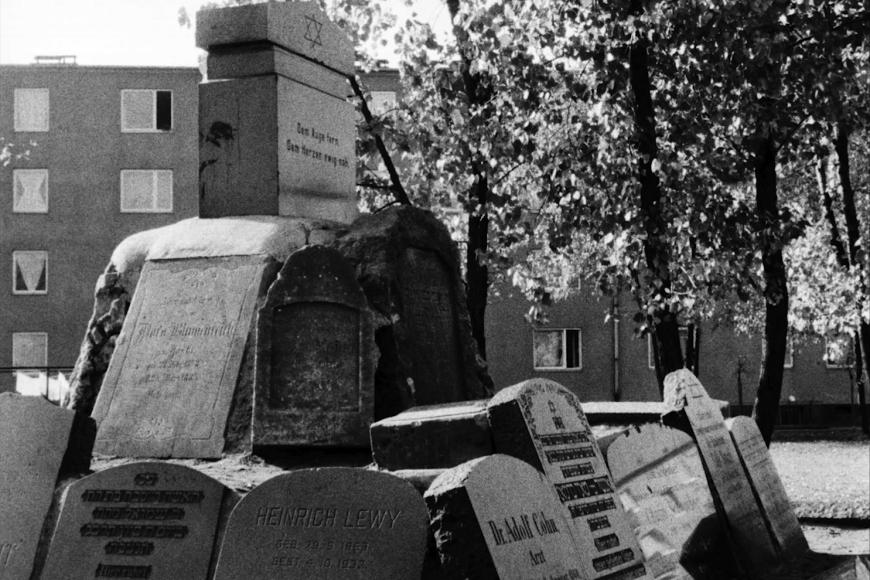
After studying at the German Academy of Film Art Potsdam-Babelsberg, Karlheinz Mund made this documentary tour of Jewish cemeteries in Berlin. The gravestones preserve the names of famous and unknown people. They preserve their places of death, where no distinction was made between the famous and the unknown: Auschwitz, Mauthausen. When the West German Short Film Festival invited Mund’s film, the committees in charge enforced one distinction after all: The images of graves defaced with anti-Semitic graffiti taken from the West German press were allowed to remain, footage of the same content filmed in East Berlin had to be removed for the theatrical release in the GDR.
1945. The Red Army are moving into Germany. A child, a Soviet soldier, a Nazi officer and a Hitler Youth have been stuck in a hotel ever since, which binds them together for years in bizarre ways.
In 1945, the Red Army are advancing on German territory, the Second World War is drawing to an end. Families are still trying to escape to America, but many plans fail. Five-year-old Sophie also loses her father and mother during the flight. They are killed by Nazi officer Scharf and a Soviet soldier named Vasily, with Hitler Youth Beckmann as a witness. The gruesome event takes place in an extremely strange hotel which henceforth will bind the four survivors to its premises in bizarre ways, no matter which rooms of the truly scary building they find themselves in. Up in the lounge, where the new customers arrive one by one, down in the kitchen, where the now grown-up Sophie prepares food, or even in an alcove near the elevator shaft, where Beckmann hides with the rats. The involuntary permanent guests age but never tire of courting Sophie. Heinrich Sabl has built an excitingly disturbing dollhouse decorated with quotes from reality for the German-Soviet history of guilt and coping. In his first feature-length animated film, on which the director worked for more than twenty years, he sends extraordinary characters on an equally extraordinary visual and acoustic time journey through the war-damaged suites of the 20th century.
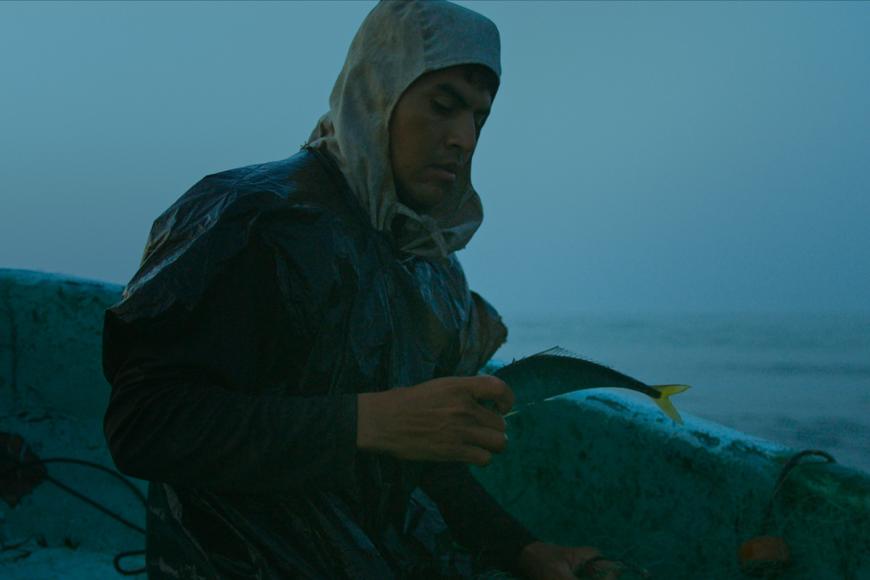
Cristobal the fisherman loves the sea and its inhabitants, which he encounters off the Mexican port of Lázaro Cárdenas. But the water is slowly turning into a toxic soup.
Cristobal, a young fisherman at work outside the Mexican port of Lázaro Cárdenas, shares his insights: Fishing is harder than working out. Also, he and the sea are connected by a progressing disease. At night he perceives what can only be grasped from the boat: the chemicals flowing into the water, the smell, the red lights of the steel mill. “Men of Salt” tells of a dilemma: What if you identify with an ecosystem that’s ceaselessly being abused?
Carolin Weidner
Credits
Director
Luis Armando Sosa Gil
Script
Luis Armando Sosa Gil
Cinematographer
Luis Armando Sosa Gil
Editor
Luis Armando Sosa Gil
Producer
Luis Armando Sosa Gil, Beuukubi Arenas
Sound
Luis Armando Sosa Gil, Carlos Cortés Navarrete, Oscar Victoria, Odin Acosta
Sound Design
Carlos Cortés Navarrete, Oscar Victoria, Odin Acosta
The black circle becomes a round creature, becomes a whale, becomes a swimmer, becomes a little deer. Coloured shapes playfully flow in and out of each other and transform.
The black circle becomes a round creature, becomes a worm, becomes a whale, becomes a swimmer, becomes a little deer. Coloured shapes playfully flow in and out of each other and transform. But before you can get dizzy, the little deer winks and runs away. A film that shows that everything is made up of many parts and that ultimately, we are all connected.
A colourful luminous river flows through the black void. Geometrical surfaces dance around wondrous organic plants. Tina Turner’s hit in an enchanting animated jazz version.
A colourful luminous river flows through the black void. Geometrical surfaces dance in small repeating loops around wondrous organic plants. The abstract lines, rectangles and semicircles briefly form animated figures. Tina Turner’s classic in the musical interpretation of Miles Davis and the animated visual world of Irina Rubina and Michelle Brand.
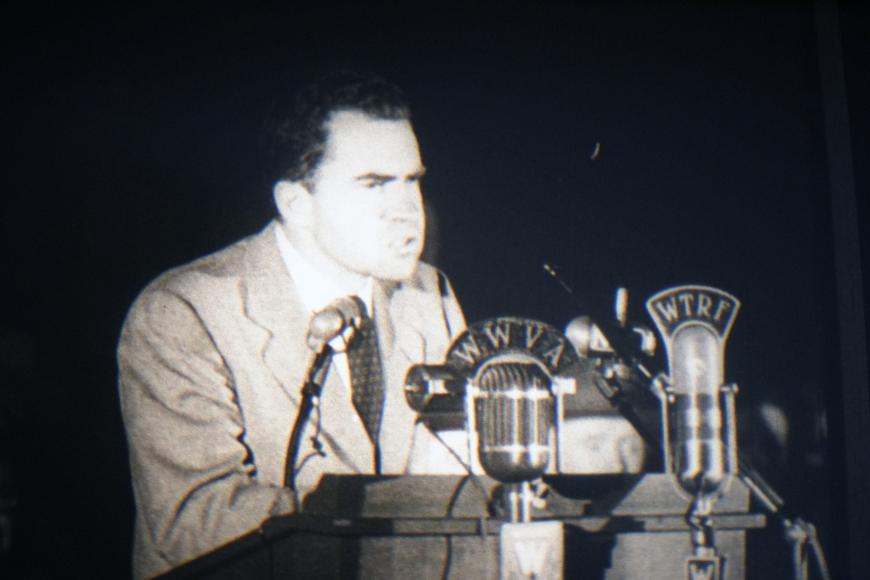
Three years before the Watergate affair brought down Richard Nixon, de Antonio proved with this gruesomely funny found footage montage that the president was a charlatan.
Three years before the Watergate affair brought down Richard Nixon, de Antonio exposed the President as a charlatan in this cruel and funny material montage. From an interview in the “Minutes” of the 1972 Leipzig Dokumentarfilmwoche: Question – “In each of your films, you expose a major American institution […]. Which did you choose for ‘Millhouse’?” De Antonio’s answer – “Nothing less than the traditional political process as a whole. The film is by no means a personal attack on Nixon. To expose a political opponent, all you need to do is rent a hall for him. The film attacks the American system, the credibility of this system, by turning on the perfect symbol of this system, the President.”
Tobias Hering, Tilman Schumacher
Credits
Director
Emile de Antonio
Cinematographer
Ed Emshwiller, Richard Kletter, Bruce Shaw, Mike Gray, Dan O’Reilly
Loneliness and threat, translated into surreal images in which the oppressive Hungarian reality of life under communism in the 1980s allegorically meets the 1956 uprising.
A feeling of fear spreads: In an apartment building, the stairs follow no logic, men get lost with a wardrobe, everyone is lonely. The surreal threat suddenly becomes real when security agents ring the doorbell: “Csengőfrász”, the symbol for the arbitrary arrest of citizens allegedly hostile to the state from the time of the Hungarian Uprising.
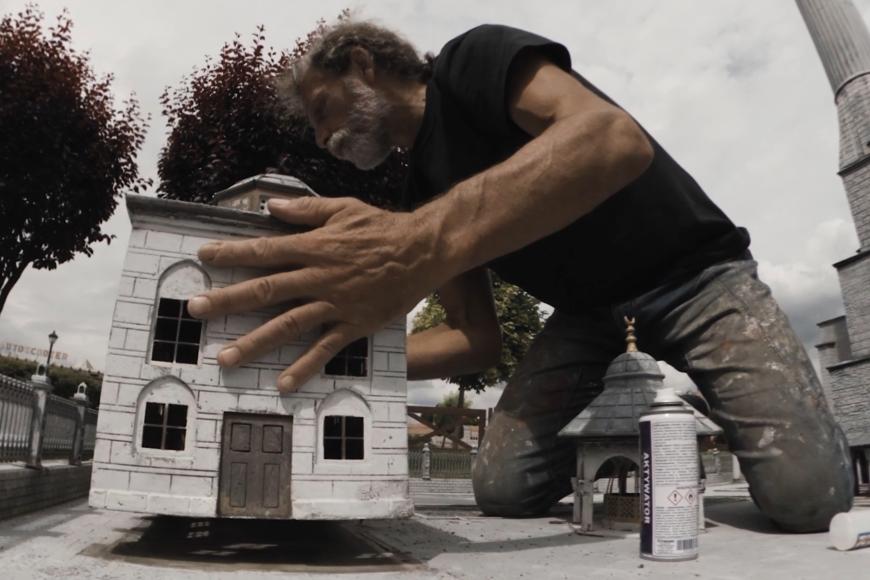
See the Sphinx, Ancient Rome and the Eiffel Tower all in one day. This 360° film plays with scaling and engages with our ideas of world-building and virtual reality as a medium.
See the Sphinx, Ancient Rome and the Eiffel Tower – all in one day! This 360° film is a visit to a miniature park and to the work of the Creator who builds it. By toying with our sense of scale, “Minitourism” engages with ideas of world-building and virtual reality as a medium. Both playful and contemplative, it invites us to consider the ways we build our world.
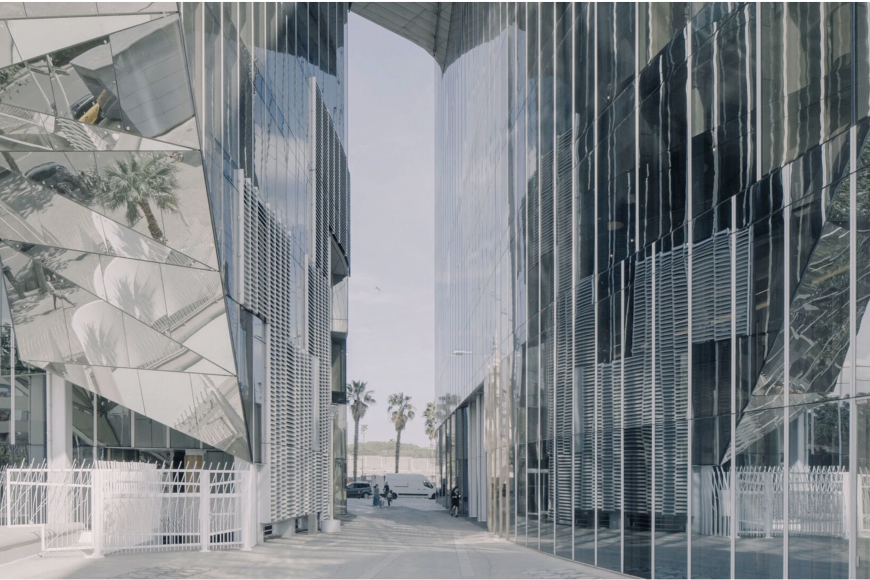
The Catalan architect Miralles died far too young. His filmic portrait is airy and dense, abrupt and flowing, unconditionally stubborn, itself reminiscent of a Miralles design.
More than twenty years have passed since the death of Catalan architect Enric Miralles. He left iconic traces with his buildings, not just in and around Barcelona – the Scottish parliament in Edinburgh is also based on his designs. Maria Mauti chooses a poetic approach to her impressive protagonist, in eleven variations. They take us from the Igualada cemetery to a community centre in Hostalets de Balenyà, a gym in Huesca or the Torre Marenostrum office skyscraper in Barcelona. The architect’s home with its open and at the same time labyrinthine character is given a major role, becoming the starting point and epicentre of a unique mind. Maria Mauti carefully scans the still lively architectures, stages them. In Huesca, the smell of a sweating soccer team seems to mingle with the omnipresent cool raw concrete, while a group of Spanish cowboys and cowgirls shake their leather boots in the futuristic community centre. Despite the tragic note that comes from the work of the prematurely deceased, “Miralles” is not without a certain wit. This poised essay which combines personal and theoretical statements achieves a multi-layered quality that is in itself evocative of a Miralles design: airy and dense, abrupt and fluid, always idiosyncratic.
Carolin Weidner
Credits
Director
Maria Mauti
Cinematographer
Ciro Frank Schiappa
Editor
Núria Esquerra
Producer
Antonio Chavarrías, Alba Bosch
Sound
Eva Valiño, Bernat Fortiana, Leo Dogan, Lucía Herrera
World Sales
Yvette De los Santos
Nominated for:
Silver Dove,
Prize of the Interreligious Jury,
FIPRESCI Prize
Scenes of a marriage as a minimalist, vibrating black and white animation: A woman and a man in a room. A fly rotates around the lightbulb and the couple around themselves.
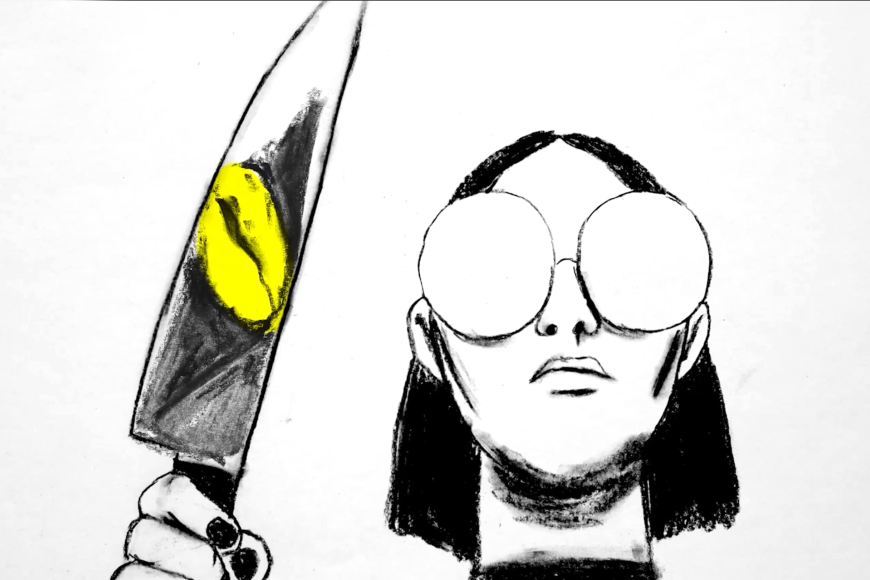
A fly rotates around a lightbulb, a spoon turns in a cup. Everything moves in circles here, including the life of the couple. He looks at his mobile phone, she does the sun salutation. Even her somersaults don’t make him look up. The minimalist black and white animation begins to vibrate. The monotony gets out of rhythm. She imagines him as a fly and chases him. Scenes of a marriage, reflected in the yellow eyes of a gecko.
Anke Leweke
Credits
Director
Marta Magnuska
Script
Marta Magnuska
Editor
Ewa Golis, Marta Magnuska
Producer
Piotr Szczepanowicz, Grzegorz Wacławek
Co-Producer
Sabine Andersone
Sound
Michał Fojcik
Animation
Marta Magnuska, Kristīne Zvirbule, Mārtiņš Dūmiņš
Winner of:
Golden Dove Short Animated Film (International Competition Short Film)
When a small dog is forgotten in the midst of the arctic desert, four snow hares take heart-warming care of him. But they don’t know very much about what a dog really needs.
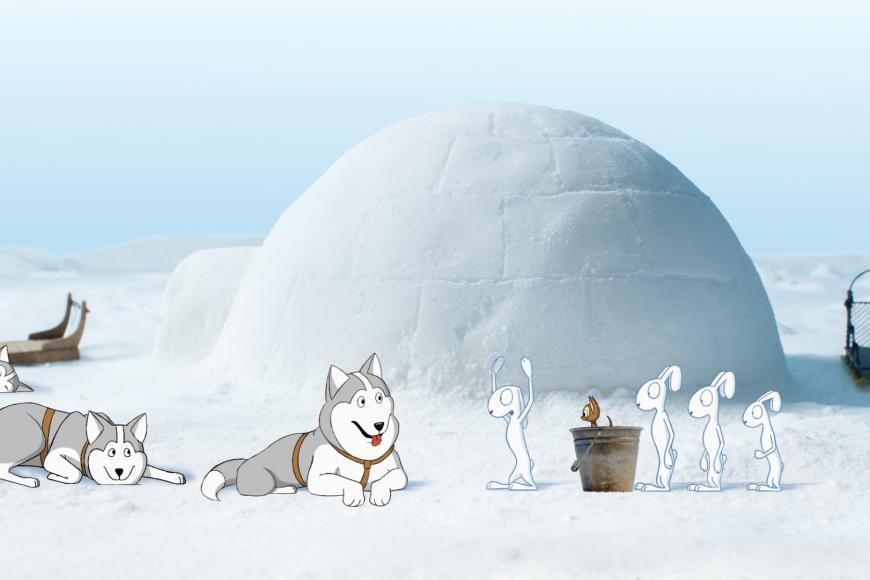
Somewhere in the eternal ice. All around nothing but snow and pleasant silence. Until a helicopter lands to drop off a group of tourists. A few quick photos are taken and off they go. The uninvited guests leave behind a pile of rubbish – and a small dog who is suddenly quite lost. Four snow hares take heart-warming care of him.
Only female ginkgo trees bear fruit. Tang Han explains with infographics, sound comments and sympathetic objectivity – both botany and cultural change.
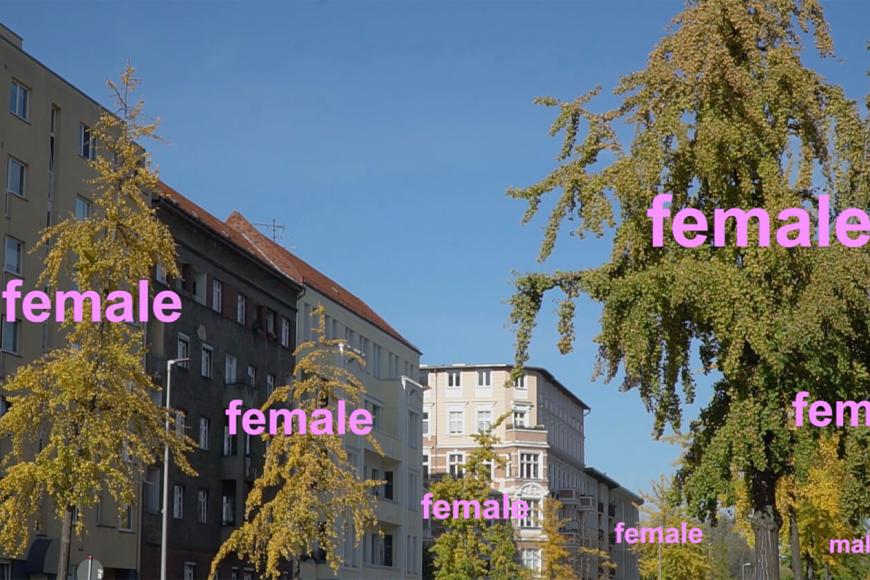
Ginkgo trees are separated by sex; only the female trees bear fruit. Once highly esteemed as natural sources of health, city dwellers today object to their pungent smell and, as gardeners, prefer the less complicated, more fragrant “fruitless” male plants. Tang Han explains with infographics, apt short sound comments and sympathetic objectivity.
Over three decades, Uwe Walter from Gelsenkirchen has become part of the Japanese village community of Miyama. This moves him at last to say goodbye to the past.
There’s probably no other citizen of Gelsenkirchen who has ever mastered Nō singing and playing the Shakuhachi flute as authentically as Uwe Walter. He has lived in the mountain village of Miyama north of Kyoto for three decades and emulates the local residents, whether they earn their living on the fields, breeding cattle or hunting. People tend their gardens, repair fences to keep away the macaques and grow their own rice. Uwe has become perfectly Japanese, at one with his environment.
However well-suited his Ruhr area wit makes him as a figure of identification, the camera keeps a respectful distance, more reserved than Uwe himself. Only at one point does it come touchingly close: When he is forced to say goodbye to an essential part of his past in the interest of the village community. But the real subject of this film is not the German with his greyish blonde curls but rather that very community, portrayed by Rainer Komers in bittersweet polyphony. It emerges in the children’s games, the adults’ pursuits and the old people’s tales, in the summer downpours of the rainy season, the white moon over the nocturnal village and the blood-red leaves of autumn.
Christoph Terhechte
Credits
Director
Rainer Komers
Script
Gregor Bartsch
Cinematographer
Rainer Komers
Editor
Gregor Bartsch
Producer
Rainer Komers
Sound
Uwe Walter, Yuki Morimoto, Michel Klöfkorn, Oscar Stiebitz
Score
Uwe Walter, Yuki Morimoto
World Sales
Joachim Kühn
Broadcaster
Doris Hepp
Key Collaborator
Hiroko Inoue
Nominated for:
VER.DI Prize for Solidarity, Humanity and Fairness
Just before a five-year creative break as “Moderat”, the members of the band speak freely about interpersonal matters and the dynamics of their electrifying cooperation.
Competition for the Audience Award Short Film 2022
Documentary Film
Germany
2022
21 minutes
German
Subtitles: 
English
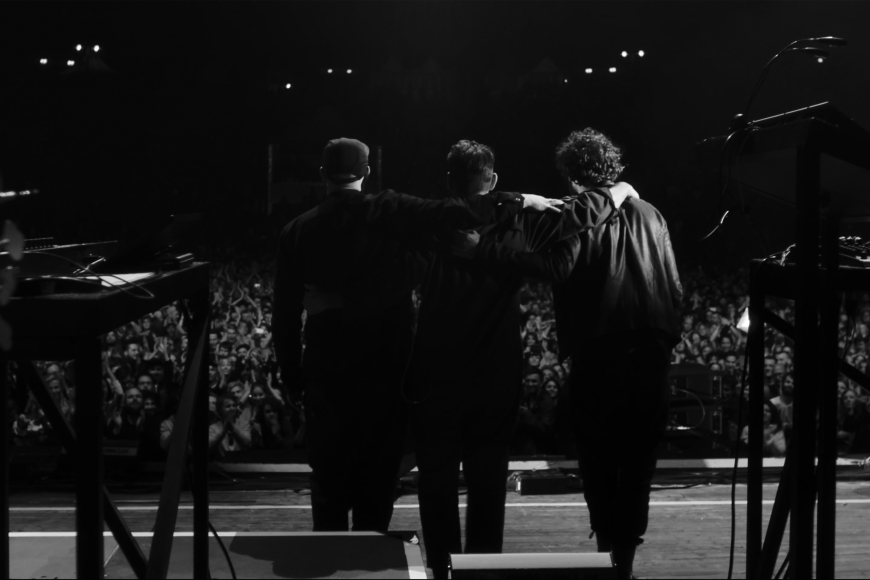
After years of touring together, the Berlin supergroup “Moderat” decided in 2017 to go on a (recently terminated) hiatus. “The Last Days” portrays the three protagonists of “Intelligent Dance Music” at their most human. Black and white images taken around their last concert tour serve as a projection surface for off-screen interviews in which Sascha, Szary and Gernot describe each other, allowing deep insights into their artistic dynamics.
Please note:Stroboscopic effects are used in this film.
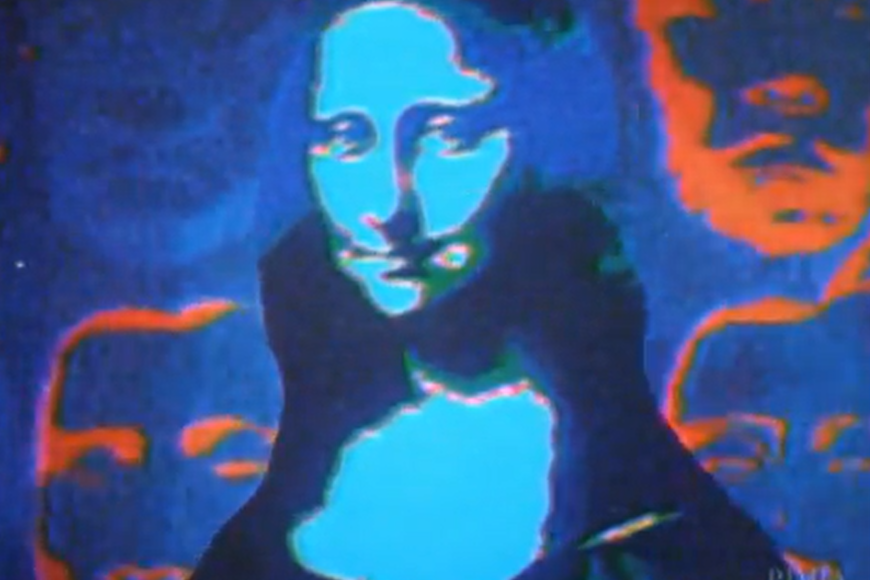
In the first ever use of the Scanimate video synth in Japan, Matsumoto takes the Mona Lisa on a journey through surreal landscapes, animating her into a shimmering psychedelic vision.
Using the Scanimate video synthesizer, da Vinci’s portrait of Lisa del Giocondo embarks on a surreal journey through real and artificial landscapes. In doing so, Toshio Matsumoto projects a kind of fantasy world of electronic images, exploding colour and movement onto his subject, animating Mona Lisa into a shimmering psychedelic vision accompanied by an abstract electronic soundtrack.
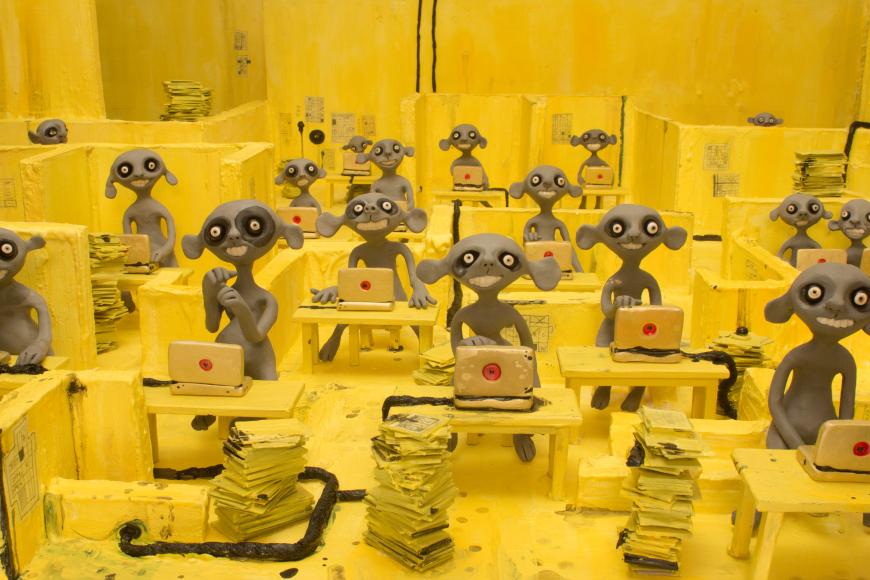
In Hamsterland, everybody is 100 percent happy and stress-resistant. An entertaining polemic on hyper capitalist, neoliberal societies that makes you smile.
Competition for the Audience Award Short Film 2022
Animated Film
Serbia,
Slovenia,
Slovakia
2022
10 minutes
English
Subtitles: 
English
In Hamsterland, everybody is 100 percent happy. Their religion is statistics and the perfect employee is young, a team player and stress-resistant. Even the most mindless computer jobs and piece work drudgery are fun, without exception. Until one day something goes wrong after all and the mantras “think positive” and “follow your dreams” are temporarily silenced. An entertaining polemic on hyper capitalist, neoliberal societies that makes you smile.