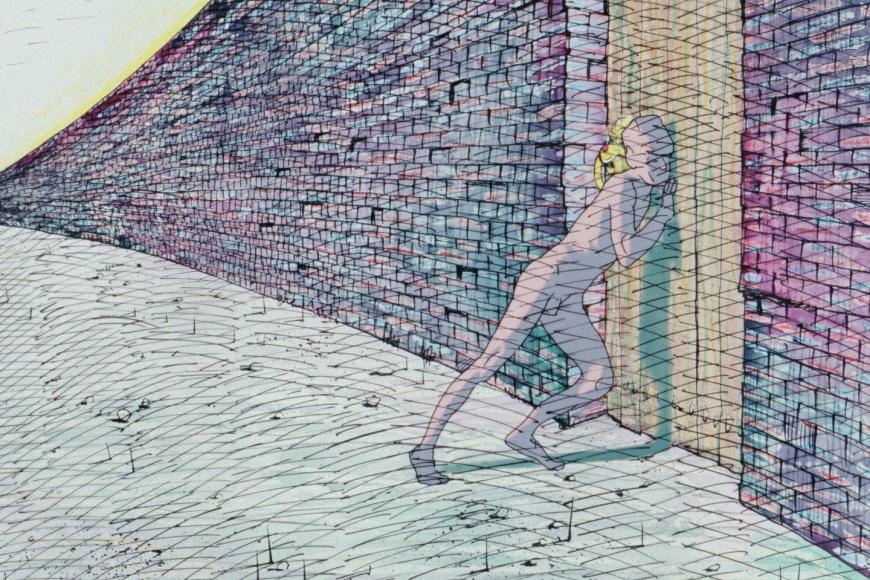
A wall stands in a barren, inhospitable landscape, insurmountable. While the birds are flying unhindered through the air, a human being struggles in vain to open a door in the wall. First as a small child, then as an adult, finally as an old man. When the door at last unexpectedly gives way, it seems too late. A dark allegory by the Leipzig-based painter and graphic artist Rainer Schade.
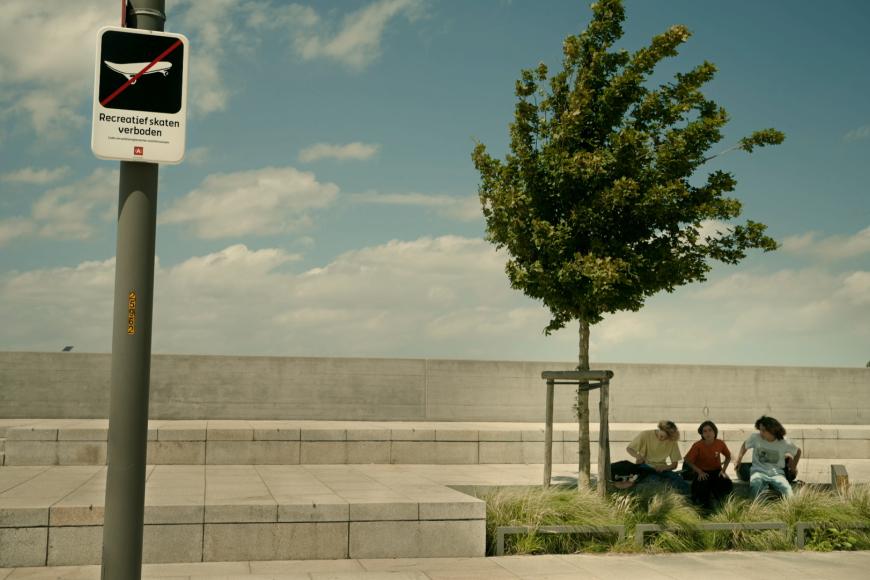
Pippa and Victoria are avid skaters. But there are “NO SKATING” signs at every corner. A street contest is needed to find allies and take back the streets.
Pippa and Victoria’s favourite pastime is skating. But there are new frustrating “NO SKATING” signs cropping up everywhere in the city. The two refuse to let this get them down and forge a plan to take back the city. They want to organise a street contest to find more allies – and to finally skate again!
Two Southern Sudanese children look back at their experiences of slavery. The authentic 2003 sound recording expands into an animated space in children’s colours.
Nine-year-old Abuk and 15-year-old Machiek have survived an ordeal. Like many Southern Sudanese children, they were robbed and enslaved by militias. In 2003, after their liberation, they visited Sweden to talk about their experiences. The authentic sound recording expands into animated space and supplies the voiceover for images of fear and memories in children’s colours.
Author Zemira’s grandmothers lived in different cultural and religious spheres: one in predominantly Muslim Bosnia, the other in Christian-influenced Slovenia.
A wonderful example of a TV documentary that transcends the limitations of the TV screen. “Slices of Time” tells the story of two women born during the First World War who saw the Austro-Hungarian Monarchy collapse and a new state form: Yugoslavia. The two grandmothers of the author Zemira Alajbegović Pečovnik lived in different cultural and religious spheres – one in predominantly Muslim Bosnia, the other in Christian-influenced Slovenia – and yet were connected through their children and grandchildren. Global and personal history, childhood, love and wars intertwine.
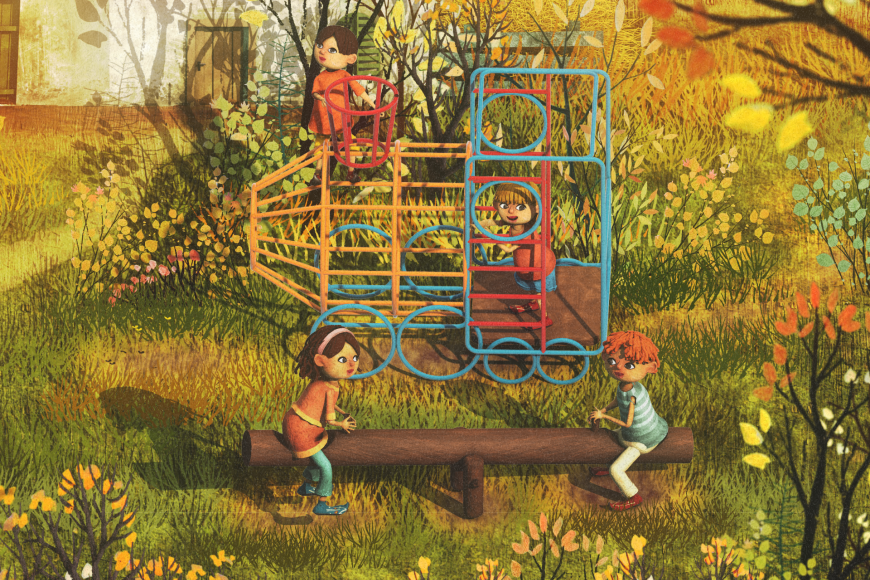
When the children wake up in the morning, all their slippers are gone. Is Slipper Keeper Kitty behind this? The children set out to find their shoes again …
The sun is shining and all the kids are playing happily all day long. At night they fall into their beds exhausted, carelessly kicking off their slippers. The next morning brings a surprise: All the slippers are gone! Well, it must have been Slipper Keeper Kitty who got them, the parents shrug. The children set out to find their shoes again …
Bizarre animations of strange beauty on a metal plate, set to Free Jazz. Light reflexes. Lines and circles that take on human or insect form, merge and dissolve.
Bizarre animations of strange beauty on a metal plate, set to Free Jazz. Light reflexes. Lines and circles that take on human or insect form, merge and dissolve. Sometimes a voice from offscreen gives directions, demands a new plate. Then everything starts again – but differently. The realization dawns slowly: This is an expedition to an underworld that generates silently communicating ghost lights.
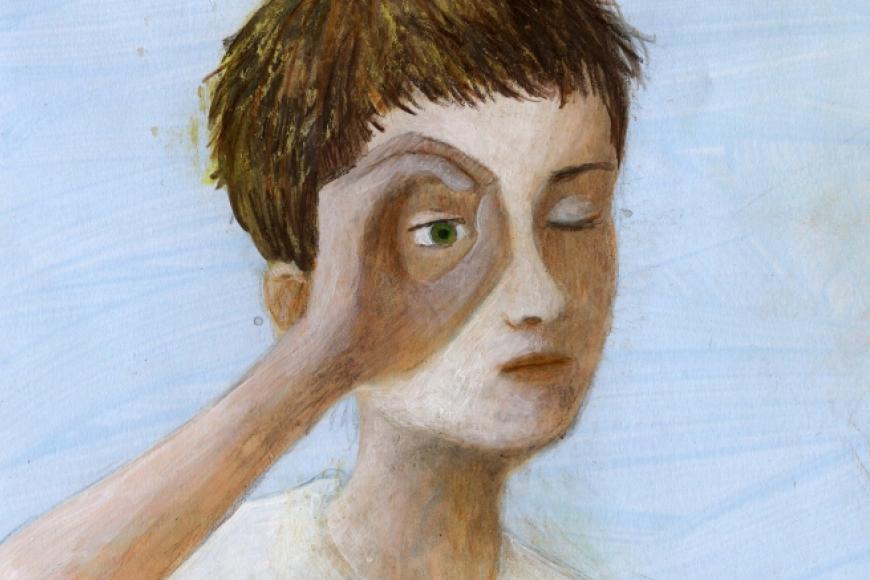
Born blind, the tragic hero of this film sees his surroundings with a delay of seven years. The images from the past become a curse that’s irreconcilable with his present life.
Competition for the Audience Award Short Film 2022
Animated Film
Poland,
Portugal
2022
11 minutes
English
Subtitles:
None
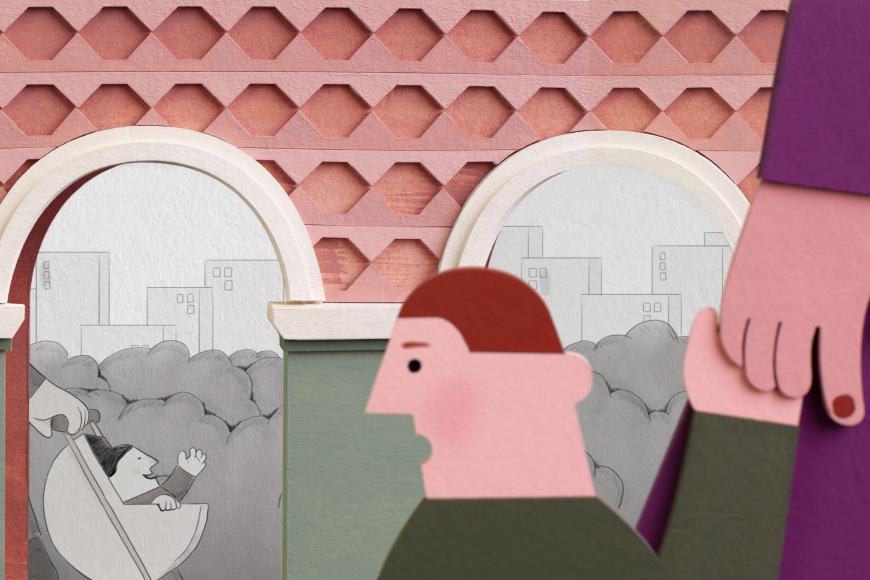
Born blind, the hero of this film turns seven before he begins to see images from the past that soon follow him like a curse. Like the stars in the night sky, what he sees has often long since passed away and gone out. In this tragic masterpiece by the directing duo Kijek/Adamski, the almost tangible pastel-coloured cut-out technique of the present-day narrative contrasts with delicate black and white 2D animations that represent the shadows of what is lost.
Christoph Terhechte
Credits
Director
Katarzyna Kijek, Przemysław Adamski
Script
Katarzyna Kijek, Przemysław Adamski
Cinematographer
Katarzyna Kijek, Przemysław Adamski
Editor
Katarzyna Kijek, Przemysław Adamski
Producer
Piotr Szczepanowicz, Grzegorz Wacławek
Co-Producer
Przemysław Adamski, Katarzyna Kijek, Bruno Caetano
Sound
Philip Lenkowsky, Carlos Abreu, Miguel Gonçlaves
Score
Piotr Kaliński
Animation
Katarzyna Kijek, Przemysław Adamski, Ala Nunu, João Gonzalez, Jakub Kaczmarek, Bartosz Stępnik, Hugo Sequeria
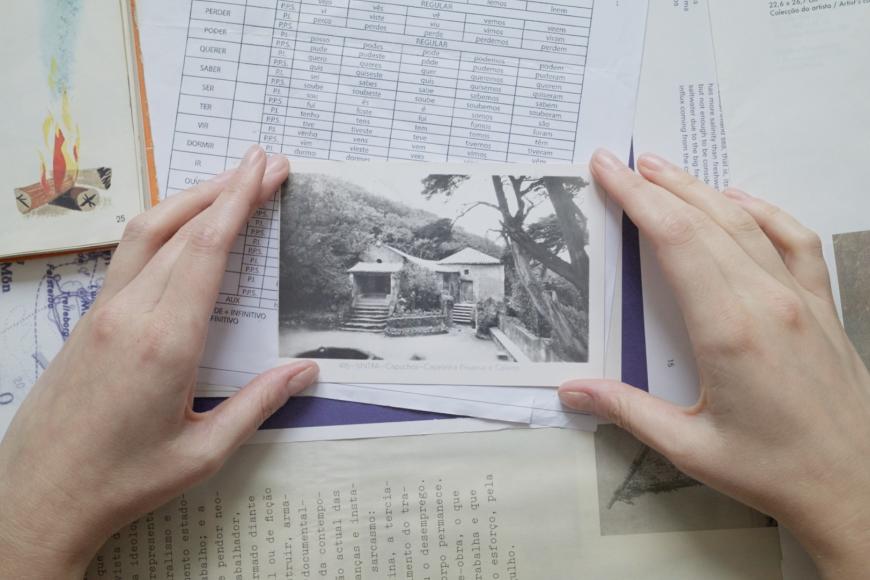
Learning a foreign language is like creating another self. How can you speak it without losing your own sound, without dissolving completely in it – and still be heard and noticed? This film is a charming and intellectually fastidious attempt to navigate the complexities of language, identity and trauma.
To do this, the filmmaker resorts to her own biography. Because Russia invaded Ukraine when Daryna Mamaisur, who comes from Kyiv, was in Portugal for a Doc Nomads graduate course. Home and the search for it became the defining factors of this work, as well as the traumatic situation of only being able to “witness” the difficult situation from a distance. She, the Ukrainian in Portugal, learns Portuguese. She lets the new words for “war,” “explosion” and “attack” roll off her tongue. She compares them with the soft, intimate sound of her native language, with the sound of Kyiv. Friends send audio and visual recordings from Ukraine which, combined with animations, become a multilayered essay and finally a testimony – for the resilience of language and culture, no matter where they are spoken and lived, and not least for the power of the artistic documentary, which can make speech and sound possible.
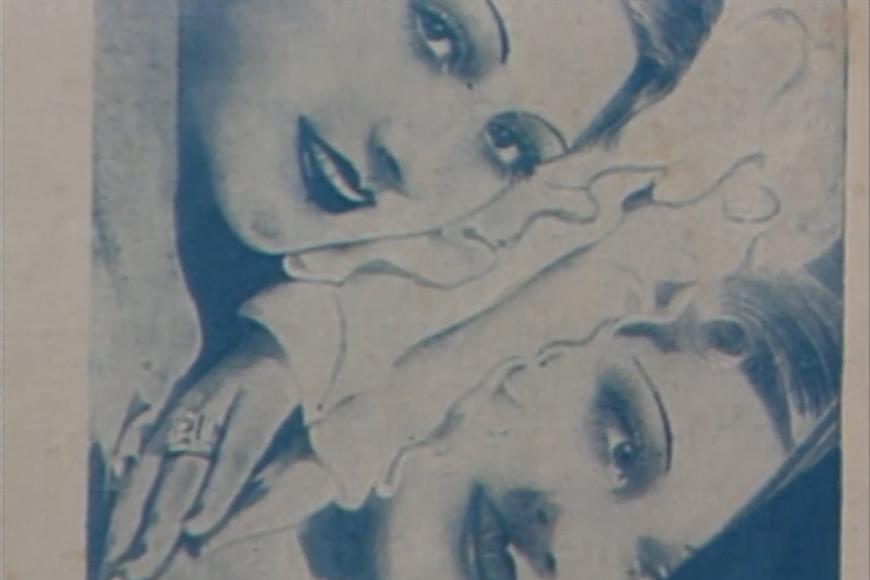
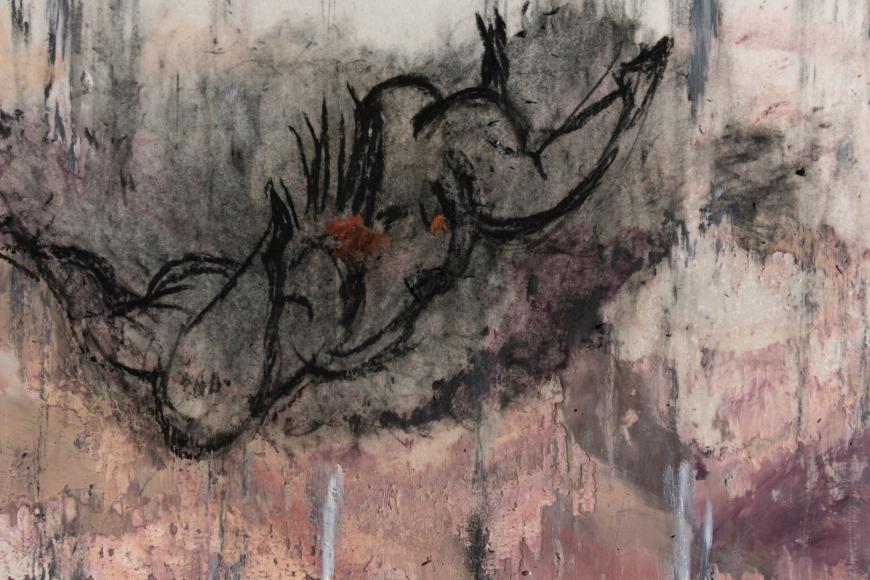
Using different techniques and materials – from charcoal pencils via watercolour to oil paints, against the backdrop of a photo – Chinese-American animation artist Renee Zhan has created a sensual, impressive and extremely original visualization of a well-known piece of wisdom: “Sex with an ex is the best.” The chance encounter of two former lovers at a station seems to trigger not only memories but also unsuppressible lust: anima porn in top form!
A demonstration set in an apocalyptic fantasy world with parable-like references to reality of how creatures (can) react when they are confronted with existential misery.
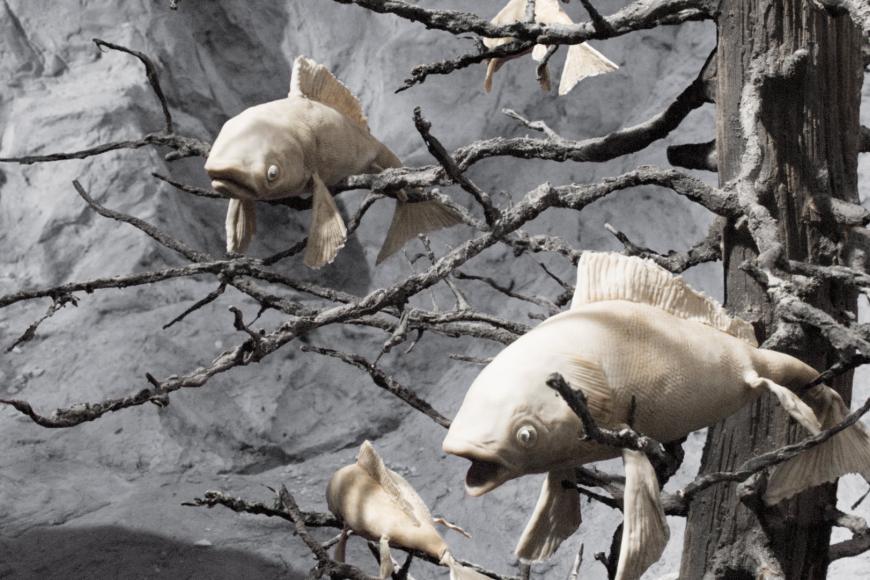
With his multiple award-winning animation, Jonatan Schwenk has created a haunting parable about compassion and solidarity. Mute creatures with burning eyes suddenly find themselves confronted with the distress of another species. At first their reaction is hesitant and stoic. But when the other species’ misery begins to disturb their peace of mind, they take action … “Sog” captivates with many creative ideas on the level of animation, succeeding in creating archaic images that look both abstract and realistic. Without a single word, the film makes us experience what a lack of empathy can lead to and that there are always at least two options for action.
In search of the cat Leo a boy roams through sunny, crayon coloured fields. Drifting without a care is part of the last throes of childhood before it ends.
In search of the cat Leo a boy roams through sunny fields. Drifting without a care and digging up treasures in the mysterious darkness of the barn are the last throes of childhood before it ends. The crayon colours of this summer are overlaid with the whispering and rustling of shelter – and a premonition. Mara Cerri and Magda Guidi sharpen our senses for the impressions of a confusing age.
In the Israeli-Palestinian conflict, the GDR explicitly supported the UN Partition Plan at first, only to adopt an increasingly one-sided position from 1965 onwards.
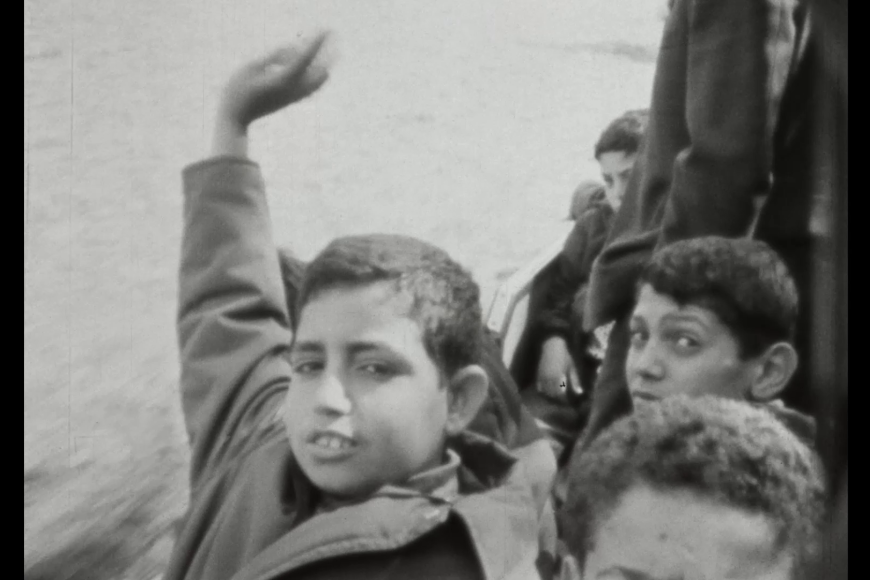
Under the banner of international solidarity, Arab children from refugee camps in Jordan are spending a holiday in the GDR in 1970. This political gesture ties in with the recently redefined position of the GDR in the Israeli-Palestinian conflict. At the World Youth Festival in 1973, Yasser Arafat was already seen standing next to Erich Honecker on camera.
Life instructions from nowhere: “Take a deep breath, say YEEES!” But the anonymous guru becomes a chattering flâneur through his own psychedelic universe of problems.
A voice from nowhere proclaims life instructions: “Take a deep breath, say YEEES! … and stop being boring!” But rules and authority gradually elude the anonymous instructor. He becomes a chattering, contradictory flâneur through the universe of his problem-fraught private affairs. Those therapy units have a really sneaky design.
André Eckardt
Credits
Director
Patrick Buhr
Script
Patrick Buhr
Editor
Patrick Buhr
Producer
Ute Dilger
Sound
Marvin Horsch, Donghee Nam, Jonathan Kastl
Animation
Patrick Buhr
Narrator
Erik Hansen
Performer
Vanja Smiljanić, Sina Seifee, Lia Sudermann, Matthias Conrady
The sun is setting in the jungle. The little monkey rocks from leaf to leaf. His dreams are wild and colourful … A filmic lullaby that definitely won’t make anyone fall asleep.
The sun is slowly setting in the jungle. The little monkey closes his eyes. He rocks and glides from one green leaf to the next, gently drifting off into sleep. But what is this? Suddenly the world of dreams becomes darker, more colourful and wilder. Mysterious plants, creatures and shapes are lining the path through the night … “Somni” is a filmic lullaby, though no one is likely to fall asleep here.
Children who play judges teach the neighbour’s boy a lesson. A scenario of bullying, based on Charles Bukowski, shows murderous group dynamics in rough comic book style.
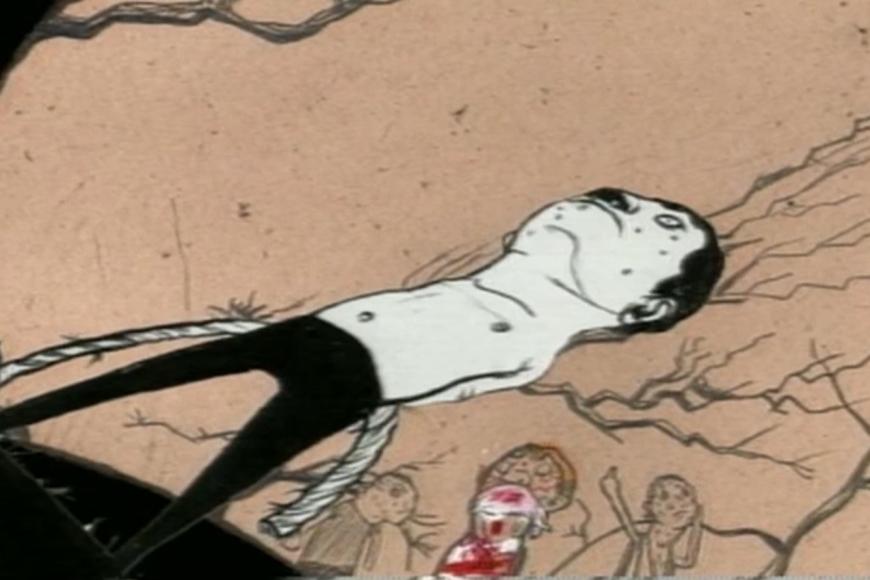
A harrowing scenario of bullying based on a short story by Charles Bukowski, whose language is translated authentically into a rough comic book style. A children’s gang teach the neighbour’s boy a lesson. It’s their duty, the self-styled righteous ones tell themselves. What starts out like a game in a framework of dominance and banal irrationality escalates into murderous group dynamics.
The daily routine in the life of a young couple: getting up, eating soup, daydreaming … Surreal animated photo collages and electro-acoustic sounds turn the inside out.
The daily routine in the life of a young couple: getting up, squeezing blackheads, eating soup, daydreaming … Zbigniew Rybczyński reworks real-life images to create surreal collages in order to visually turn the inside out. He is supported by the Polish composer Eugeniusz Rudnik, whose great electro-acoustic inventiveness shifts playfully back and forth between naturalism and alienation.